
Archimedes: driving more sustainable solutions
In accordance with the Chemical Industry Methodology for Portfolio Sustainability Assessment (PSA) established by the World Business Council for Sustainable Development (WBCSD), this program is applied to all sales and all new product developments within the Group.
By the end of 2025, 91% of the Group’s sales to third parties—including all acquisitions, even the most recent ones—had been assessed in this manner.
Key stages of the Archimedes assessment
Within each Business Line, sales are broken down into units called PARCs (Product–Application–Region Combination) to account for products in their specific applications and the geographic regions where they are sold.
The PARC is the valuation unit, and each Business Line thus evaluates all of its solutions, which are divided into anywhere from a few dozen to several hundred PARCs, depending on the Business Line. The Group’s entire portfolio of solutions is thus divided into approximately 1,400 PARCs.
The assessment of each PARC is conducted by a committee comprising the Group’s Head of Sustainable Offer and experts from the Business Line, notably the Product, Business, and Industrial Regulatory Managers.
This Archimedes assessment takes into account, to the extent of available data, the entire value chain from raw materials to the end of a product’s life cycle and includes manufacturing processes.
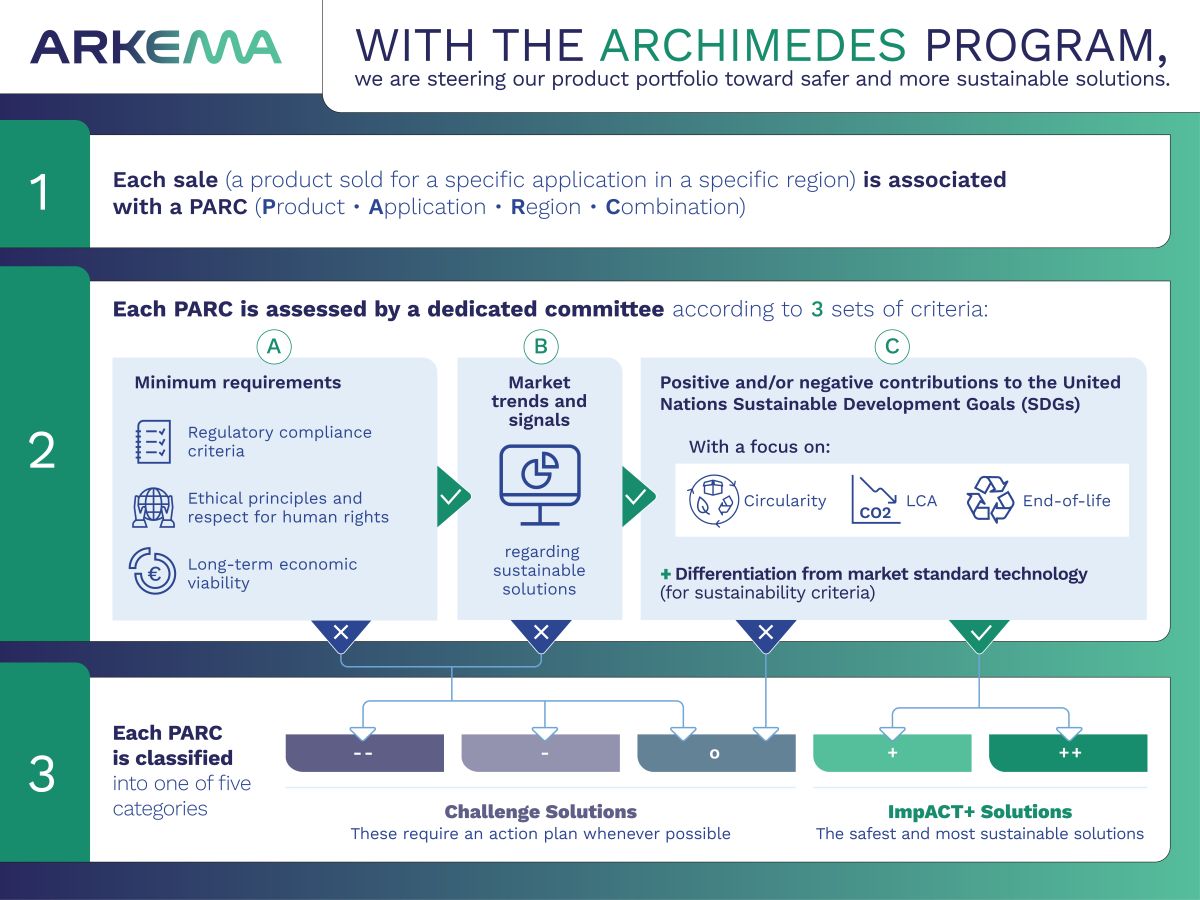
It is conducted using three sets of criteria:
A. Minimum requirements, including:
- Regulatory criteria that reflect the Group’s commitments regarding product responsibility in the areas of safety, health, and the environment, and which go beyond regulatory compliance (medium- and long-term trends in the regulatory framework are also taken into account);
- Ethical principles and respect for human rights;
- Factors related to long-term economic viability;
B. Market trends and expectations regarding more sustainable solutions, for which an assessment of the criticality of the impact is conducted; and
C. The contribution to the UN Sustainable Development Goals (SDGs), using as a reference the SDGs most relevant to the Group’s activities; as well as how the solution stands out in terms of sustainable development criteria compared to market standard technology.
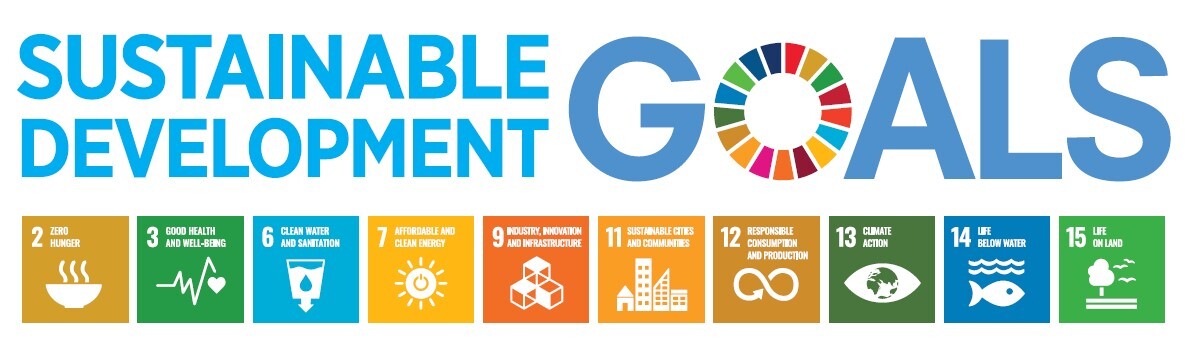
At the end of the assessment, the Solutions are classified into different contribution levels rated from “--” to “++”.
ImpACT+ Solutions (Scores + and ++): the safest and most sustainable solutions
Solutions classified in the ImpACT+ category are those that, based on the decision tree, meet all three sets of the aforementioned criteria:
- Meet the minimum requirements, particularly regulatory requirements,
- Are aligned with market trends and expectations,
- Have a positive impact relative to market standards on at least one of the SDGs, and do not generate a significant negative impact on the other SDGs.
These solutions thus represent the safest and most sustainable options in the Group’s portfolio of solutions.
A specific subgroup (score ++) highlights solutions that stand out for their performance, exceeding market standards.
Neutral and Challenge Solutions
(Scores 0, -, and --)
These solutions are not aligned with one of the evaluation criteria: minimum requirements, market expectations, or contributions to the SDGs. They are therefore classified into subgroups based on an assessment of the severity of the gap and the actions to be implemented.
Appropriate action and improvement plans are developed by the Business Lines, including plans to substitute substances of concern and substances of very high concern (SVHCs) in both the Group’s raw materials and products.
Development and Objectives of the Archimedes Program
Since 2023, the Archimedes program has been supported by a dedicated digital tool designed to facilitate the evaluation of solutions—particularly with regard to regulatory criteria—to maintain traceability of evaluations, and to consolidate results.
This tool helps the Group’s Business Lines manage their roadmaps for both the transformation of Challenge solutions and the development of ImpACT+ solutions.
The ImpACT+ indicator has shown significant progress, reaching 57% of sales that make a significant contribution to the Sustainable Development Goals by 2025. This progress is due to robust growth in the Group’s sustainable product portfolio as well as a reduction in solutions that are less conducive to sustainable development.
To strengthen its commitment to sustainable offerings, Arkema has set a strategic goal: a 60% share of ImpACT+ sales by 2030. To achieve this goal, the Group is implementing proactive measures across three key areas: continuous improvement of solutions, sustainable innovation in products and applications, and the active promotion of ImpACT+ solutions.
In implementing the Archimedes assessment method, regulatory analysis is the first step to be carried out. It aims to identify, anticipate, and prioritize current and future regulatory constraints affecting Arkema Group products or product families, in order to guide decisions regarding product portfolio management.
This analysis enables the prioritization of substitution or sustainable innovation efforts and supports decisions to phase out or reformulate certain products.
The regulatory requirements assessment phase considers all substances present at concentrations exceeding 10 ppm in finished products, as well as in all raw materials and ingredients (such as catalysts, reagents, or solvents, where applicable) used during manufacturing.
These same regulatory requirements and principles are applied to the assessment of products manufactured and sold in all regions of the world (Europe, AMAS, and Asia).
In line with the Group’s strategy to reduce the use of all hazardous substances in the products it sells, the analysis takes into account an expanded list of substances that includes:
- Substances included in the REACH Candidate List (Substances of Very High Concern—substances officially identified as “of very high concern” within the meaning of Article 57 of the REACH Regulation). Substances with the following properties may be identified as SVHCs:
- Carcinogenic, mutagenic, or toxic to reproduction (CMR Categories 1A and 1B)
- Persistent, bioaccumulative, and toxic (PBT) or very persistent and very bioaccumulative (vPvB)
- Substances presenting an equivalent level of concern (ELoC) to Categories I and II (endocrine disruptors (ED), PMT,….).
- Substances classified as CMR Category 1 in Annex VI of the CLP Regulation (EC) No. 1272/2008
- The ODS (Ozone-Depleting Substances) list under the Montreal Protocol and the POP (Persistent Organic Pollutants) list under the Stockholm Protocol.
- An “SVHC-Like” category: Substances confirmed to be hazardous that are not included in the REACH Candidate List (Annex VI of the CLP Regulation (EC) No. 1272/2008, ECHA’s ED (Endocrine Disruptor) and PBT lists) and are not included in Annex VI of the CLP Regulation (CLH Intention Register—CMR Category 1).
- An “SVHC-Suspected” category: A supplementary list of suspected hazardous substances to consider and anticipate future regulatory changes over the next 2, 5, or 10 years.
- The analysis also incorporates restrictions on use (legal limitations imposed on the manufacture, use, or placing on the market of a substance due to its risks to health or the environment), as defined in Europe in Annex XVII of the REACH Regulation
In its latest version from April 2026, the list of substances taken into account includes between 5,050 and 5,100 different substances.
The regulatory lists considered are updated in the analysis tool at least twice a year.
This assessment makes it possible to identify, in particular, all products and raw materials containing these substances at concentrations exceeding 0.1%. These products will be included in the Challenge solutions with varying levels of criticality, depending on:
- The urgency of action required to account for potential future regulatory changes;
- The effort required to substitute the raw material containing the substance.
These products will be subject to a plan to substitute them with safer alternatives whenever possible or to reformulate them.