
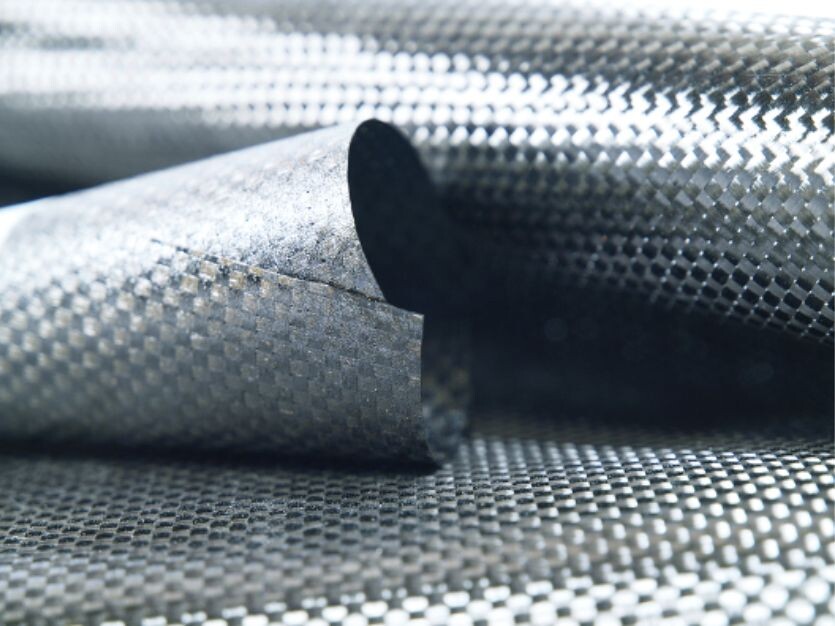
Composites stand out as lightweight, high-performance alternatives to metals, which are known for being heavy and carbon-intensive in many industries.
However, their recyclability at the end of their life cycle poses a significant challenge, as the majority of composite resins used today are thermosetting, with no possibility of recovering them through heating. For many years, Arkema has therefore chosen to develop a product portfolio and expertise unique in the world in thermoplastic resins that enable the manufacture of recyclable composite parts. Major players in the marine and aerospace sectors have already successfully adopted these materials.
What is a composite material?
A composite material is defined as the synergistic combination of at least two immiscible materials, that is, materials that cannot dissolve into one another. Together, these materials form a third material, the composite, whose properties exceed the sum of the properties of its individual components. The key elements of a composite material are:
- the matrix, which is the material that acts as a binder and gives the final object its shape. In modern industry, this is often a polymer, a category of materials in which Arkema possesses cutting-edge expertise;
- and the reinforcement, which is the element dispersed within the matrix and which gives the composite its structural properties. Its role is to withstand the mechanical stresses exerted on the composite. The most common reinforcements are fibers, particularly glass, carbon, or, in some cases, natural fibers such as hemp or flax.
The interface between these two components is also a crucial element. The bond between the matrix and the reinforcement must be strong for the synergy to work and for the composite to achieve the desired properties.
By combining the complementary properties of their constituent materials, fiber-reinforced polymer composites exhibit unique characteristics. They offer a combination of high stiffness and strength, and they also resist fatigue caused by repeated loads or vibrations, which is a major advantage when used in large-scale structural components such as wind turbine blades.
Thanks to their light weight, composites can replace metal parts which are inherently heavier while maintaining comparable strength and performance. This property is particularly valuable in sectors such as aerospace, where it can lead to a significant reduction in CO₂ emissions.
Finally, by their very nature, composites are designed to be “custom-made.” From the moment they are assembled, the fiber layers are arranged to precisely withstand the forces to which the final part will be subjected. “Design engineers analyze the part’s load cases under service conditions, then determine the fiber orientation and the number of layers,” explains Jérôme Pascal, Technical and Business Development Manager for Kepstan® PEKK at Arkema. “This manufacturing approach, tailored to the intended use, is embedded in the very DNA of composites.” This optimized and targeted design also contributes to greater productivity by reducing material usage and streamlining manufacturing processes.
The result: superior mechanical performance and a significant reduction in material consumption.
Arkema, an expert in the thermoplastic composites value chain
For Arkema, the composites market represents a sector with a promising future in which it is gradually strengthening its presence. The Group is positioned upstream in the composites value chain, specializing in the design of polymers that can be used as composite matrices, and also manufactures semi-finished products by combining its own polymer matrices with fibers (such as carbon fibers) sourced from other industrial partners.
Arkema’s Adhesives division, Bostik, offers customized adhesive technologies that come into play further downstream in the value chain, once the composite parts have been manufactured. Since these parts cannot be welded or bolted without risk of damage, structural adhesives are essential. Bostik offers a wide range of such products.
Finally, Arkema aims to deliver cutting-edge innovations through a unique offering of thermoplastic polymers for creating composite matrices. Historically, the composites market has been dominated by thermosetting resins. While these resins are durable, they have a major drawback: once cured, they become permanently set and cannot be melted down for reuse. In contrast, thermoplastic resins, once cured, can be heated and reused without losing their original properties.
Thermoplastics are also inherently stronger than thermosets, meaning they are more resistant to crack propagation. Finally, their responsiveness to heat makes thermoplastics more malleable, allowing them to be reshaped even after the composite part has been manufactured.
Arkema’s portfolio for the composites sector
One of Arkema’s key solutions for the composites market is the Elium® thermoplastic resin.
This material offers a major technical advantage: depolymerization, which enables near-perfect chemical recycling. To recover the resin, simply heat it and it returns to its original liquid state. This process also allows the fibers to be recovered intact and reused, which is crucial given their high cost and the fact that their production is often highly carbon-intensive.”
This approach is part of Arkema’s overall eco-design strategy.
Our methyl methacrylate-based structural adhesives share the same chemical base as Elium® resin. This prevents them from contaminating the resin when it is melted, a risk associated with more traditional epoxy adhesives and helps preserve its recyclability. Such compatibility is essential. for the effective processing of composite materials at the end of their life cycle.”
Beyond its recyclability, Elium® resin enables the design of lightweight yet strong parts, making it a material with high potential for a wide range of applications.
The marine industry, in particular, is already making extensive use of this resin.
In early 2025, Arkema officially formed an industrial alliance with several major players in the marine sector, including Beneteau, a global manufacturer of sailboats and motorboats. The goal of this partnership is to accelerate the transition toward a circular marine industry, notably by enabling the manufacture of boats from recycled composite materials. Numerous projects have already emerged from this collaboration, such as the Oceanis Yacht 60, the first Beneteau production model built using Elium® resin: the material enhances the boat’s hull performance and comfort while making it more durable and easier to recycle at the end of its life. Previously, Arkema’s composite solutions had already established ties with the marine industry through the Neo Sailing Technologies shipyard (formerly Lalou Multi), which had used Elium® liquid acrylic resin to design the Ocean Fifty Arkema racing trimaran.
Thanks to its unique properties, Elium® resin offers a solution to the growing problem of “marine graveyards.” At the end of their life, boats made from thermosetting resins cannot be chemically recycled and end up abandoned in ports or on beaches. Thanks to the Elium® liquid thermoplastic resin, these boats can now be recycled and enter a circular economy cycle, rather than becoming permanent waste.
In the aerospace sector, composite materials are transforming aircraft design and construction. By replacing traditional metals such as aluminum or titanium, they reduce component weight by 20 to 50%[1] , which helps lower fuel consumption and CO₂ emissions from aircraft. Their excellent fatigue resistance also gives them a longer service life, making aircraft both more efficient and more sustainable.
Arkema’s Kepstan® PEKK is one of the materials driving this evolution. With exceptional mechanical strength and a melting point ranging from 300 to 360 °C depending on the grade, it offers an alternative to certain metal parts, particularly when combined with carbon fibers. Already used in aerospace components, Kepstan® PEKK offers key benefits for manufacturers: production cycles can be reduced from several hours to just a few minutes, increasing production rates, while the ability to reshape and weld thermoplastic composites provides new design freedom and additional weight savings. Its thermoplastic nature also makes it recyclable.
This momentum is reflected in the HELUES project, conducted in collaboration with Hexcel, which focuses on developing next-generation thermoplastic composite solutions for aerospace structures. Several of these innovations are currently undergoing qualification by major aerospace manufacturers, with the goal of creating lighter, more fuel-efficient, and more sustainable aircraft.
[1] From Metal to Composites: How Materials Are Revolutionizing Aerospace - aviationweek.com - 2025
Finally, Arkema is developing UDX® PA11 tapes, composed of unidirectional carbon fibers impregnated with a thermoplastic polymer matrix: these tapes are semi-finished products in which the fibers are all aligned in the same direction to optimize strength and stiffness along the main load axis.
UDX® PA11 tapes consist of a 100% bio-based and recyclable thermoplastic matrix derived from polyamide 11. This material enables the production of lightweight, high-performance, and more durable composite parts, particularly for applications in the fields of mobility, sports, and hydrogen storage.