Solvent-Free Battery Technology Powered by PVDF Emulsion Innovation
Discover how PVDF emulsion enables solvent-free battery technology for more sustainable, high-performance energy storage. Learn about its role in cathode binders and separator coatings in advanced PVDF battery systems.
Manufacturing battery cell with more sustainable solutions
As the global demand for high-performance batteries accelerates—driven by electric vehicles, renewable energy storage, and portable electronics—the industry faces a critical challenge: how to manufacture batteries sustainably without compromising performance. Enter solvent-free battery technology, a transformative approach that eliminates solvents from the electrode and separator coating process.
At the heart of this innovation lies PVDF emulsion, a game-changing material that enables more sustainable and more efficient battery production.
What is the role of PVDF in the battery cell?
In lithium-ion and sodium-ion battery cells, PVDF plays a critical role as both a cathode binder and a separator coating material. As a cathode binder, PVDF ensures strong adhesion between active materials and the current collector, maintaining structural integrity during charge-discharge cycles and preventing particle detachment. Its chemical resistance and thermal stability make it ideal for high-voltage cathode chemistries. When used as a separator coating—especially in emulsion form—PVDF enhances mechanical strength and electrolyte compatibility.
What is PVDF emulsion and why it matters
Polyvinylidene fluoride (PVDF) has long been the gold standard binder in lithium-ion and sodium-ion battery cells. Traditionally used in solvent-based processes, PVDF ensures mechanical stability, electrochemical resistance, and excellent adhesion. But the future demands more.
Kynar® PVDF emulsion—a water-based alternative—delivers the same high-performance characteristics without the use of organic solvents like NMP or acetone. This emulsion-based binder is engineered for:
✅ High purity and electrochemical stability
✅ Superior mechanical integrity under stress
✅ Optimal slurry viscosity and processability
✅ Compatibility with dry and aqueous coating processes
Solvent-Free Battery Technology: A Path Forward
The shift to solvent-free battery technology is more than a trend—it's a necessity. By replacing toxic solvents with water-based or dry processes, manufacturers can:
- Reduce environmental impact and carbon footprint
- Lower operational and capital expenditures
- Improve workplace safety and regulatory compliance
Arkema’s proprietary Kynar® PVDF emulsion technology is leading the charge, offering unmatched control over particle size, dispersion, and coating performance. Whether used in separator coatings or dry electrode manufacturing, emulsion PVDF enables dot-to-dot contact and stable adhesion—critical for long-term battery reliability.
Download the white paper: deep dive into PVDF battery innovation
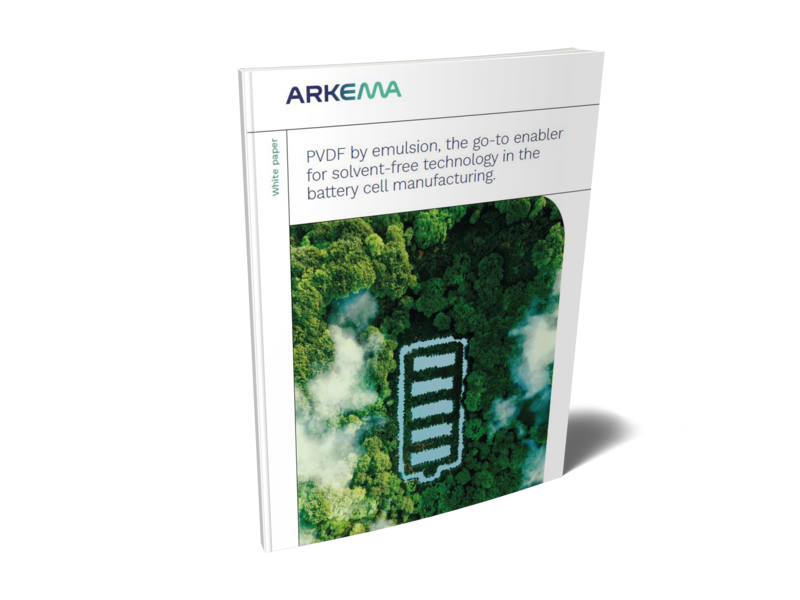
Ready to explore the science and strategy behind this breakthrough? Our comprehensive white paper, “PVDF by Emulsion: The Go-To Enabler for Solvent-Free Technology in Battery Cell Manufacturing”, reveals:
- Comparative analysis of solvent-based vs. solvent-free processes
- Case studies on separator coating and dry electrode manufacturing
- Technical insights into emulsion polymerization and powder dispersion
- Arkema’s unique approach to sustainable PVDF battery solutions